
Services
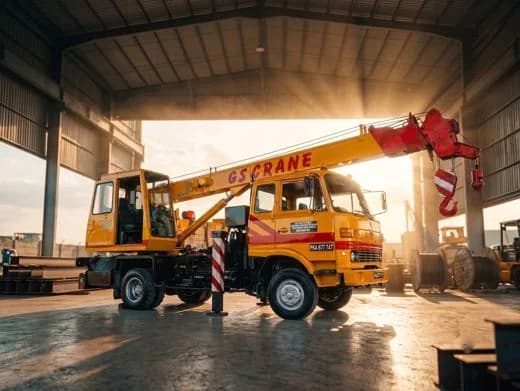
Baby crane.
Self-loading delivery for smaller construction jobs. The lorry carries its own crane behind the cab, so nothing is needed at your end — no forklift, no gantry, no second machine hired for the morning. It is a lorry that lifts its own load on and off, not a crane: when the lift itself is the job, the mobile crane is the machine.
No figures are published for this class yet, and none are estimated. Which crane class the yard runs — 3, 5 or 8/10 tonne — decides both the capacity and the licence position, so it changes what this page can honestly say yes to rather than just changing a number.
Four things worth knowing before you book one.
- Capacity is always at a radius, and the drop is a cliff.
- A published “3-tonne crane” lifts 3,030 kg at 2.4 m. At full extension on a six-section boom it lifts 130 kg. That is not a rounding — it is the same machine, and which number applies depends entirely on how far in from the lorry the load has to land. Tell us the weight and the reach and we can answer; tell us only the weight and nobody can.
- The chart figure is net of the hook.
- The hook, the slings and any accessory come off the chart value before your load does. A 3-tonne class hook is about 30 kg on its own.
- Every chart assumes the outriggers fully out on firm level ground.
- On one published 5-tonne unit at 10.58 m, running narrow outriggers cuts capacity from 1,000 kg to 240 kg — a 76% loss at the same radius. On a tight site that is the number that decides whether the job happens.
- Gross weight is not the only limit.
- A two-axle chassis can be legal on total weight and simultaneously over its rear-axle rating the moment the boom slews rearward under load. The rear axle binds before the ceiling does.